Herbin E Modern Mathematical Concepts for Engineers Part I 2025
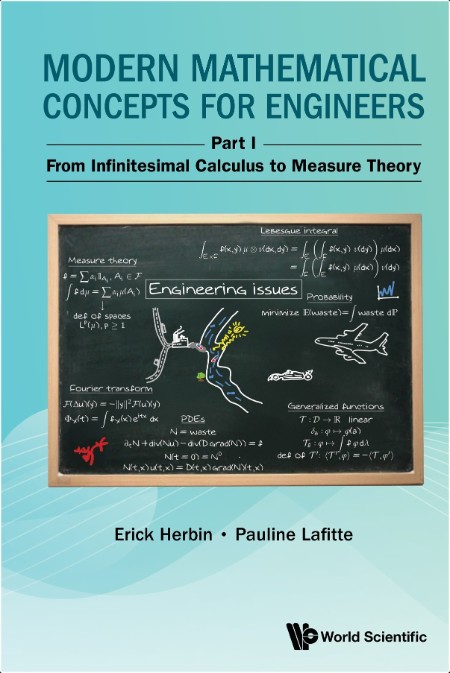
Herbin E Modern Mathematical Concepts for Engineers Part I 2025 | 10.59 MB
Title: Modern Mathematical Concepts for Engineers: Part 1 - From Infinitesimal Calculus to Measure Theory (368 Pages)
Author: Erick Herbin & Pauline Lafitte
Description:
Modern Mathematical Methods for Scientists and Engineers is a modern introduction to basic topics in mathematics at the undergraduate level, with emphasis on explanations and applications to real-life problems. There is also an 'Application' section at the end of each chapter, with topics drawn from a variety of areas, including neural networks, fluid dynamics, and the behavior of 'put' and 'call' options in financial markets. The book presents several modern important and computationally efficient topics, including feedforward neural networks, wavelets, generalized functions, stochastic optimization methods, and numerical methods.
A unique and novel feature of the book is the introduction of a recently developed method for solving partial differential equations (PDEs), called the unified transform. PDEs are the mathematical cornerstone for describing an astonishingly wide range of phenomena, from quantum mechanics to ocean waves, to the diffusion of heat in matter and the behavior of financial markets. Despite the efforts of many famous mathematicians, physicists and engineers, the solution of partial differential equations remains a challenge.
The unified transform greatly facilitates this task. For example, two and a half centuries after Jean d'Alembert formulated the wave equation and presented a solution for solving a simple problem for this equation, the unified transform derives in a simple manner a generalization of the d'Alembert solution, valid for general boundary value problems. Moreover, two centuries after Joseph Fourier introduced the classical tool of the Fourier series for solving the heat equation, the unified transform constructs a new solution to this ubiquitous PDE, with important analytical and numerical advantages in comparison to the classical solutions. The authors present the unified transform pedagogically, building all the necessary background, including functions of real and of complex variables and the Fourier transform, illustrating the method with numerous examples.
Broad in scope, but pedagogical in style and content, the book is an introduction to powerful mathematical concepts and modern tools for students in science and engineering.
Contents:
Complex Analysis and the Fourier Transform:
Applications to Partial Differential Equations:
Probabilities, Numerical and Stochastic Methods:
Readership: Advanced undergraduate students and graduate students in physical science and engineering departments; researchers and practitioners (both in industry and academia) in the same fields. Can be used as textbook for courses in: Applied Mathematics, Mathematics for Physicists, Mathematics for Engineers, at both the advanced undergraduate and graduate level. Can also be adopted for fields that use mathematical tools for modeling, such as finance.
Key Features:
DOWNLOAD:
https://rapidgator.net/file/7cabdf5d8127091e991000706aa1e5be/Herbin_E._Modern_Mathematical_Concepts_for_Engineers_Part_I...2025.rar
https://nitroflare.com/view/F17730FD1CBF27C/Herbin_E._Modern_Mathematical_Concepts_for_Engineers_Part_I...2025.rar
Modern Mathematical Methods for Scientists and Engineers is a modern introduction to basic topics in mathematics at the undergraduate level, with emphasis on explanations and applications to real-life problems. There is also an 'Application' section at the end of each chapter, with topics drawn from a variety of areas, including neural networks, fluid dynamics, and the behavior of 'put' and 'call' options in financial markets. The book presents several modern important and computationally efficient topics, including feedforward neural networks, wavelets, generalized functions, stochastic optimization methods, and numerical methods.
A unique and novel feature of the book is the introduction of a recently developed method for solving partial differential equations (PDEs), called the unified transform. PDEs are the mathematical cornerstone for describing an astonishingly wide range of phenomena, from quantum mechanics to ocean waves, to the diffusion of heat in matter and the behavior of financial markets. Despite the efforts of many famous mathematicians, physicists and engineers, the solution of partial differential equations remains a challenge.
The unified transform greatly facilitates this task. For example, two and a half centuries after Jean d'Alembert formulated the wave equation and presented a solution for solving a simple problem for this equation, the unified transform derives in a simple manner a generalization of the d'Alembert solution, valid for general boundary value problems. Moreover, two centuries after Joseph Fourier introduced the classical tool of the Fourier series for solving the heat equation, the unified transform constructs a new solution to this ubiquitous PDE, with important analytical and numerical advantages in comparison to the classical solutions. The authors present the unified transform pedagogically, building all the necessary background, including functions of real and of complex variables and the Fourier transform, illustrating the method with numerous examples.
Broad in scope, but pedagogical in style and content, the book is an introduction to powerful mathematical concepts and modern tools for students in science and engineering.
Contents:
- Functions of Real Variables:
- Functions of a Single Variable
- Functions of Many Variables
- Series Expansions
Complex Analysis and the Fourier Transform:
- Functions of Complex Variables
- Singularities, Residues, Contour Integration
- Mappings Produced by Complex Functions
- The Fourier Transform
Applications to Partial Differential Equations:
- Partial Differential Equations: Introduction
- Unified Transform I: Evolution PDEs on the Half-line
- Unified Transform II: Evolution PDEs on a Finite Interval
- Unified Transform III: The Wave Equation
- Unified Transform IV: Laplace, Poisson, and Helmholtz Equations
Probabilities, Numerical and Stochastic Methods:
- Probability Theory
- Numerical Methods
- Stochastic Methods
Readership: Advanced undergraduate students and graduate students in physical science and engineering departments; researchers and practitioners (both in industry and academia) in the same fields. Can be used as textbook for courses in: Applied Mathematics, Mathematics for Physicists, Mathematics for Engineers, at both the advanced undergraduate and graduate level. Can also be adopted for fields that use mathematical tools for modeling, such as finance.
Key Features:
- Students of physical and engineering sciences, and increasingly those in the life and social sciences, need a solid grounding in mathematical methods to understand and advance within their own discipline. Their typical mathematics training is either too formal (from a purely mathematical perspective with few real-life applications) or inadequate (fearing, or not having adequate time to take, mathematics courses). Thus, they never acquire the confidence and strength to use sophisticated mathematical methods, readily and easily, in their own discipline. This book aims to correct this problem
- The extensive explanations and examples provide much needed training in using the concepts introduced. The Applications at the end of each chapter show how useful each topic is in real-life problems
- The novel (and some unique) aspects of the book include: 1) A highly accessible presentation of the "Unified Transform" (also known as the "Fokas method") for solving partial differential equations (PDEs), including many examples and applications. A unique feature of this method is that it gives rise to very simple numerical techniques for solving a great variety of physically significant PDEs. This allows undergraduates to construct themselves graphs of the solution without the need to learn sophisticated techniques such as finite elements of finite differences. This approach is very powerful and is not presented anywhere at a level accessible to advanced undergraduate students; 2)Discussions of modern topics provide the mathematical underpinning for applications that students encounter in many modern contexts in the physical and engineering sciences. These discussions built on traditional math topics like the Fourier transform and its applications; 3) A presentation of stochastic optimization methods, building on probability theory and random numbers. Important topics discussed include Monte Carlo integration, Markov chain Monte Carlo, and the simulated annealing method. These are very useful tools, rarely presented in introductory texts, and discussed only in very specialized courses; 4) A thorough discussion of generalized functions like the delta-function and the theta-function. These tools are almost never treated in textbooks, yet in real-life applications they are ubiquitous. Examples of their use can be found throughout the book, and they are revisited in many different occasions, allowing the student to build familiarity and confidence in using them; 5) All figures were created by the authors in a manner close to what would be "blackboard sketches" to maintain the directness and liveliness of a lecture presentation. The use of color makes the comprehension of the figures much more intuitive, and helps the student create a powerful mental picture of the mathematical notions
DOWNLOAD:
https://rapidgator.net/file/7cabdf5d8127091e991000706aa1e5be/Herbin_E._Modern_Mathematical_Concepts_for_Engineers_Part_I...2025.rar
https://nitroflare.com/view/F17730FD1CBF27C/Herbin_E._Modern_Mathematical_Concepts_for_Engineers_Part_I...2025.rar

Information
Users of Guests are not allowed to comment this publication.