New Analysis and Modeling Directions in Social Interaction Science
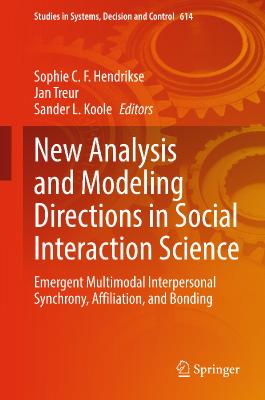
New Analysis and Modeling Directions in Social Interaction Science | 64.45 MB
Title: New Analysis and Modeling Directions in Social Interaction Science
Author: Sophie C. F. Hendrikse · Jan Treur · Sander L. Koole
Category: Nonfiction, Science & Nature, Mathematics, Applied, Computers, Advanced Computing, Artificial Intelligence, Technology, Engineering
Language: English | 661 Pages | ISBN: 3031999673
Description:
There is much scientific literature on multimodal social interaction between human and/or virtual agents, and related multimodal synchrony analysis and behavioural adaptivity within the interaction such as affiliation and bonding. However, due to its strongly cyclical character, complexity, and adaptivity, mathematical formalisation and computational simulation of it is a nontrivial topic. Moreover, the subjective, agent-oriented perspective on synchrony analysis has not yet received much attention in the literature. This book provides from an agent-oriented perspective an overview of recent work on mathematical formalisation and computational simulation of multimodal interaction, subjective multimodal synchrony analysis, and related behavioural adaptivity underlying, for example, affiliation, liking and bonding. It does so by exploiting the possibilities of multi-time-scale, multi-adaptive, multi-level self-modeling network models for agents to analyse and model these dynamic and adaptive processes formally. In this way it contributes to the development of a solid basis for social interaction science.
DOWNLOAD:
https://rapidgator.net/file/3babd216ed447b0b60a4df9d8f77f08f/New_Analysis_and_Modeling_Directions_in_Social_Interaction_Science.pdf
https://nitroflare.com/view/F127A221B06D0FB/New_Analysis_and_Modeling_Directions_in_Social_Interaction_Science.pdf
There is much scientific literature on multimodal social interaction between human and/or virtual agents, and related multimodal synchrony analysis and behavioural adaptivity within the interaction such as affiliation and bonding. However, due to its strongly cyclical character, complexity, and adaptivity, mathematical formalisation and computational simulation of it is a nontrivial topic. Moreover, the subjective, agent-oriented perspective on synchrony analysis has not yet received much attention in the literature. This book provides from an agent-oriented perspective an overview of recent work on mathematical formalisation and computational simulation of multimodal interaction, subjective multimodal synchrony analysis, and related behavioural adaptivity underlying, for example, affiliation, liking and bonding. It does so by exploiting the possibilities of multi-time-scale, multi-adaptive, multi-level self-modeling network models for agents to analyse and model these dynamic and adaptive processes formally. In this way it contributes to the development of a solid basis for social interaction science.
DOWNLOAD:
https://rapidgator.net/file/3babd216ed447b0b60a4df9d8f77f08f/New_Analysis_and_Modeling_Directions_in_Social_Interaction_Science.pdf
https://nitroflare.com/view/F127A221B06D0FB/New_Analysis_and_Modeling_Directions_in_Social_Interaction_Science.pdf

Information
Users of Guests are not allowed to comment this publication.