Metropolitan Governance and Social Inequality in Latin America From Urban Segregation to Interjur...
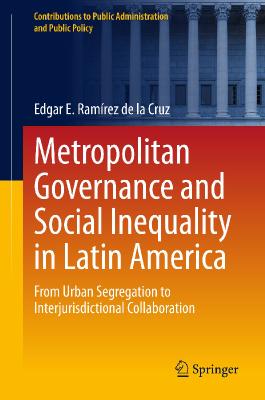
Metropolitan Governance and Social Inequality in Latin America From Urban Segregation to Interjurisdictional Collaboration | 3.35 MB
Title: Metropolitan Governance and Social Inequality in Latin America
Author: Edgar E. Ramírez de la Cruz
Category: Nonfiction, Social & Cultural Studies, Political Science, Government, Public Affairs & Administration, Public Policy
Language: English | 148 Pages | ISBN: 3032098963
Description:
This book examines metropolitan governance and interjurisdictional collaboration in Latin America, focusing on the "metropolitan problem" created by fragmented jurisdictions that produce inefficiency, inequity, and weak coordination. Moving beyond traditional metropolitan governments, it highlights interjurisdictional collaboration as a middle ground, drawing on and adapting the Institutional Collective Action (ICA) framework to contexts marked by weak rule of law and informal institutions. The book proposes that collaboration choices depend on the problem's nature, actors' preferences and capacities, and institutional settings. Through case studies of Bogotá, Buenos Aires, Mexico City, Santiago, and São Paulo, it shows how inequalities, wealth disparities, institutional frameworks, and leadership shape collaboration, particularly in transportation and environmental policy. Ultimately, it advances a dynamic view of metropolitan governance as evolving institutions that balance risks, costs, and benefits, offering a new research agenda for urban governance in Latin America.
DOWNLOAD:
https://rapidgator.net/file/6bb0d75d7c608751154b6d994f052ce6/Metropolitan_Governance_and_Social_Inequality_in_Latin_America_From_Urban_Segregation_to_Interjurisdictional_Collaboration.pdf
https://nitroflare.com/view/2967468418232F9/Metropolitan_Governance_and_Social_Inequality_in_Latin_America_From_Urban_Segregation_to_Interjurisdictional_Collaboration.pdf
This book examines metropolitan governance and interjurisdictional collaboration in Latin America, focusing on the "metropolitan problem" created by fragmented jurisdictions that produce inefficiency, inequity, and weak coordination. Moving beyond traditional metropolitan governments, it highlights interjurisdictional collaboration as a middle ground, drawing on and adapting the Institutional Collective Action (ICA) framework to contexts marked by weak rule of law and informal institutions. The book proposes that collaboration choices depend on the problem's nature, actors' preferences and capacities, and institutional settings. Through case studies of Bogotá, Buenos Aires, Mexico City, Santiago, and São Paulo, it shows how inequalities, wealth disparities, institutional frameworks, and leadership shape collaboration, particularly in transportation and environmental policy. Ultimately, it advances a dynamic view of metropolitan governance as evolving institutions that balance risks, costs, and benefits, offering a new research agenda for urban governance in Latin America.
DOWNLOAD:
https://rapidgator.net/file/6bb0d75d7c608751154b6d994f052ce6/Metropolitan_Governance_and_Social_Inequality_in_Latin_America_From_Urban_Segregation_to_Interjurisdictional_Collaboration.pdf
https://nitroflare.com/view/2967468418232F9/Metropolitan_Governance_and_Social_Inequality_in_Latin_America_From_Urban_Segregation_to_Interjurisdictional_Collaboration.pdf

Information
Users of Guests are not allowed to comment this publication.