The Participatory Role of Indigenous Women Environmental Conservation in the Himalaya Region, Vol...
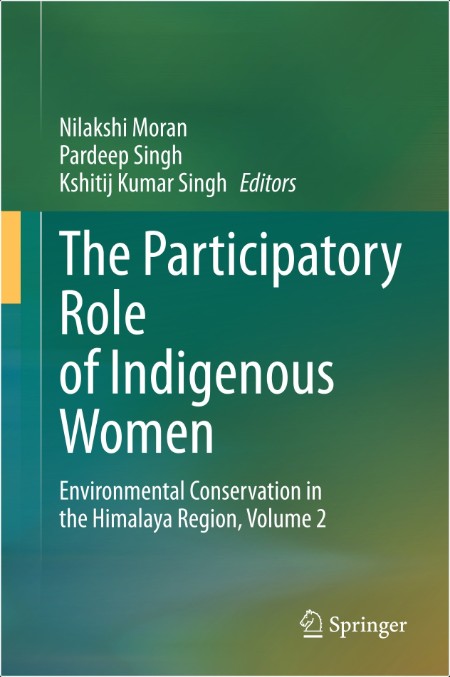
The Participatory Role of Indigenous Women Environmental Conservation in the Himalaya Region, Volume 2 | 8.38 MB
Title: TheParticipatoryRoleofIndigenousWomen
Author: NilakshiMoran·PardeepSingh·KshitijKumarSingh
Category: Nonfiction, Science & Nature, Technology, Environmental, Science, Biological Sciences, Environmental Science, Social & Cultural Studies, Social Science, Gender Studies
Language: English | 331 Pages | ISBN: 3032240581
Description:
The Participatory Role of Indigenous Women in Environmental Conservation in the Himalayan Region offers a comprehensive exploration of how Indigenous women leverage their Traditional Ecological Knowledge (TEK) to safeguard fragile ecosystems, uphold cultural heritage, and enhance community resilience. Scientific studies increasingly affirm that women's participation in natural resource management leads to more adaptive, equitable, and sustainable conservation outcomes, with biodiversity flourishing when decision-making processes incorporate their perspectives. This volume spans fifteen chapters and highlights the intersection of gender, environmental stewardship, and policy frameworks. It critically examines how land rights and legal structures empower or restrict women's involvement in conservation efforts. The research underscores that gender-sensitive policy reforms address inequalities and contribute to more effective water conservation, sustainable agriculture, and forest management. Women's leadership in seed preservation, organic farming, and rainwater harvesting has been shown to stabilize food systems and mitigate climate volatility, reinforcing community-driven resilience strategies. The book also underscores how cultural preservation is deeply intertwined with ecological stewardship. Indigenous practices such as storytelling, herbal medicine, and sustainable textile production serve as living archives of ecological wisdom, passing vital conservation knowledge across generations. Recognizing and integrating these traditions into broader conservation initiatives ensures cultural continuity and environmental sustainability. Additionally, the resurgence of customary laws and Indigenous governance structures highlights women's pivotal role in maintaining community norms prioritizing biodiversity and ecosystem balance. The challenges of modernization, globalization, and tourism are also critically examined. While these forces often disrupt traditional customs and resource management practices, Himalayan women have demonstrated remarkable adaptability. The book showcases community-based enterprises--such as ecotourism cooperatives and sustainable handicraft industries—where women strategically integrate modern technology with TEK, generating economic opportunities while minimizing environmental degradation. Further, the book evaluates international policy frameworks, advocating for more substantial institutional support and multi-stakeholder collaborations. Evidence suggests that education and gender-inclusive curricula are crucial in cultivating a new generation of environmental leaders. This volume also provides practical insights into climate adaptation strategies, spotlighting women-led initiatives that drive transformative ecological stewardship. This book illuminates a path toward sustainable, inclusive, and community-centered environmental conservation in the Himalayan region by bridging scientific and Indigenous knowledge systems
DOWNLOAD:
https://rapidgator.net/file/4eaf7445aabc98c0504d4c0b148fadd0/The_Participatory_Role_of_Indigenous_Women_Environmental_Conservation_in_the_Himalaya_Region_Volume_2.rar
https://nitroflare.com/view/C1DE43D67F40502/The_Participatory_Role_of_Indigenous_Women_Environmental_Conservation_in_the_Himalaya_Region_Volume_2.rar
The Participatory Role of Indigenous Women in Environmental Conservation in the Himalayan Region offers a comprehensive exploration of how Indigenous women leverage their Traditional Ecological Knowledge (TEK) to safeguard fragile ecosystems, uphold cultural heritage, and enhance community resilience. Scientific studies increasingly affirm that women's participation in natural resource management leads to more adaptive, equitable, and sustainable conservation outcomes, with biodiversity flourishing when decision-making processes incorporate their perspectives. This volume spans fifteen chapters and highlights the intersection of gender, environmental stewardship, and policy frameworks. It critically examines how land rights and legal structures empower or restrict women's involvement in conservation efforts. The research underscores that gender-sensitive policy reforms address inequalities and contribute to more effective water conservation, sustainable agriculture, and forest management. Women's leadership in seed preservation, organic farming, and rainwater harvesting has been shown to stabilize food systems and mitigate climate volatility, reinforcing community-driven resilience strategies. The book also underscores how cultural preservation is deeply intertwined with ecological stewardship. Indigenous practices such as storytelling, herbal medicine, and sustainable textile production serve as living archives of ecological wisdom, passing vital conservation knowledge across generations. Recognizing and integrating these traditions into broader conservation initiatives ensures cultural continuity and environmental sustainability. Additionally, the resurgence of customary laws and Indigenous governance structures highlights women's pivotal role in maintaining community norms prioritizing biodiversity and ecosystem balance. The challenges of modernization, globalization, and tourism are also critically examined. While these forces often disrupt traditional customs and resource management practices, Himalayan women have demonstrated remarkable adaptability. The book showcases community-based enterprises--such as ecotourism cooperatives and sustainable handicraft industries—where women strategically integrate modern technology with TEK, generating economic opportunities while minimizing environmental degradation. Further, the book evaluates international policy frameworks, advocating for more substantial institutional support and multi-stakeholder collaborations. Evidence suggests that education and gender-inclusive curricula are crucial in cultivating a new generation of environmental leaders. This volume also provides practical insights into climate adaptation strategies, spotlighting women-led initiatives that drive transformative ecological stewardship. This book illuminates a path toward sustainable, inclusive, and community-centered environmental conservation in the Himalayan region by bridging scientific and Indigenous knowledge systems
DOWNLOAD:
https://rapidgator.net/file/4eaf7445aabc98c0504d4c0b148fadd0/The_Participatory_Role_of_Indigenous_Women_Environmental_Conservation_in_the_Himalaya_Region_Volume_2.rar
https://nitroflare.com/view/C1DE43D67F40502/The_Participatory_Role_of_Indigenous_Women_Environmental_Conservation_in_the_Himalaya_Region_Volume_2.rar

Information
Users of Guests are not allowed to comment this publication.