Godot 4 Best Practices Practical techniques and strategies for efficient, scalable game development
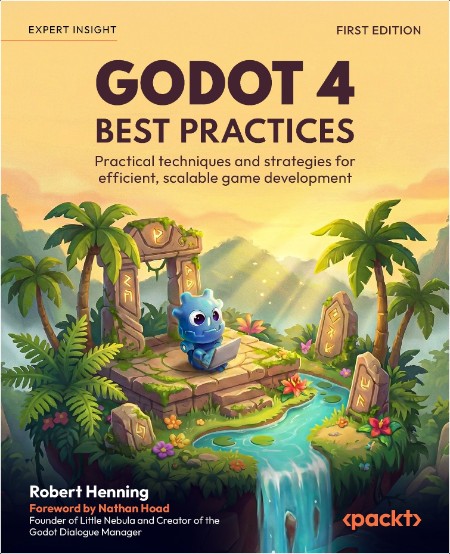
Godot 4 Best Practices Practical techniques and strategies for efficient, scalable game development | 25.02 MB
Title: Godot 4 Best Practices Practical techniques and strategies for efficient, scalable game development
Author: Robert Henning
Category: Interactive & Multimedia Technology, Computer Games Programming, Game Programming
Language: English | 342 Pages | ISBN: 9781835465110
Description:
Elevate your Godot 4 development skills with SOLID principles, game architecture patterns, and scalable workflows. Learn to create maintainable systems, organize projects, and build release-ready games that grow beyond prototypes
Free with your book: DRM-free PDF version + access to Packt's next-gen Reader*
"Robert shares clear ways of thinking that help you make informed choices. The patterns in this book are practical habits that let a project keep growing without collapsing under its own weight." - Nathan Hoad, Creator of the Godot Dialogue Manager
Author's Note
To avoid common copy-paste issues in digital formats, we advise entering code manually or using the official GitHub codebase included with the book.
Key Features
Book Description
Many Godot projects start as quick prototypes but become difficult to maintain as they grow. Deep node hierarchies, tightly coupled scripts, and expanding gameplay systems can slow development and make it harder to add features, fix bugs, and ship with confidence. Godot 4 Best Practices addresses those challenges by focusing on architectural practices that help projects stay scalable and maintainable.
You'll start by applying the SOLID principles to Godot's node and script model, learning when to choose scenes or scripts, how to keep hierarchies shallow, and when data-driven Resources are a better fit than extra nodes. Next, you'll implement core design patterns, including signals and notifications for decoupling, state machines, strategy-based AI, and swapping deep inheritance for modular components. You'll also apply Factories, Builders, Commands, and Services with clear Godot examples, so systems stay flexible and testable. Finally, you'll structure larger projects with data-driven saves and preferences, as well as layered gameplay architecture to avoid God classes.
By the end, you'll write cleaner GDScript, organize large scenes with confidence, and build systems that are easier to test, maintain, and extend. No hype—just proven practices for building Godot projects that scale.
*Email sign-up and proof of purchase required
What you will learn
Who this book is for
This book is ideal for intermediate and advanced Godot developers who already know how to make simple games but want to adopt professional practices for larger, more complex projects. It is especially useful for indie developers, technical leads, and small teams who need scalable workflows, as well as educators and advanced students who want to learn how to apply SOLID principles and design patterns in Godot. If you've ever struggled with messy prototypes, monolithic scripts, or unscalable Scene Trees, this book will show you how to organize, refactor, and future-proof your projects.
DOWNLOAD:
https://rapidgator.net/file/00ccedf40d51f33f912dcc7a57ef5c60/9781835465110.rar
https://nitroflare.com/view/73E50E8A391D623/9781835465110.rar
Elevate your Godot 4 development skills with SOLID principles, game architecture patterns, and scalable workflows. Learn to create maintainable systems, organize projects, and build release-ready games that grow beyond prototypes
Free with your book: DRM-free PDF version + access to Packt's next-gen Reader*
"Robert shares clear ways of thinking that help you make informed choices. The patterns in this book are practical habits that let a project keep growing without collapsing under its own weight." - Nathan Hoad, Creator of the Godot Dialogue Manager
Author's Note
To avoid common copy-paste issues in digital formats, we advise entering code manually or using the official GitHub codebase included with the book.
Key Features
- Apply SOLID principles and proven design patterns in Godot 4
- Build scalable game architecture using components, events, and services
- Refactor prototypes into maintainable, production-ready projects
Book Description
Many Godot projects start as quick prototypes but become difficult to maintain as they grow. Deep node hierarchies, tightly coupled scripts, and expanding gameplay systems can slow development and make it harder to add features, fix bugs, and ship with confidence. Godot 4 Best Practices addresses those challenges by focusing on architectural practices that help projects stay scalable and maintainable.
You'll start by applying the SOLID principles to Godot's node and script model, learning when to choose scenes or scripts, how to keep hierarchies shallow, and when data-driven Resources are a better fit than extra nodes. Next, you'll implement core design patterns, including signals and notifications for decoupling, state machines, strategy-based AI, and swapping deep inheritance for modular components. You'll also apply Factories, Builders, Commands, and Services with clear Godot examples, so systems stay flexible and testable. Finally, you'll structure larger projects with data-driven saves and preferences, as well as layered gameplay architecture to avoid God classes.
By the end, you'll write cleaner GDScript, organize large scenes with confidence, and build systems that are easier to test, maintain, and extend. No hype—just proven practices for building Godot projects that scale.
*Email sign-up and proof of purchase required
What you will learn
- Apply SOLID principles in Godot's node and script system
- Decide when to use scenes, scripts, or Resources for logic
- Use signals, State, and Strategy patterns for gameplay logic
- Build modular, component-based systems over inheritance
- Automate instancing with Factory and Builder patterns
- Decouple input, audio, and saves with Command and Service patterns
- Separate logic from data with Resources and data-driven design
- Structure gameplay systems using scalable architectural patterns
Who this book is for
This book is ideal for intermediate and advanced Godot developers who already know how to make simple games but want to adopt professional practices for larger, more complex projects. It is especially useful for indie developers, technical leads, and small teams who need scalable workflows, as well as educators and advanced students who want to learn how to apply SOLID principles and design patterns in Godot. If you've ever struggled with messy prototypes, monolithic scripts, or unscalable Scene Trees, this book will show you how to organize, refactor, and future-proof your projects.
DOWNLOAD:
https://rapidgator.net/file/00ccedf40d51f33f912dcc7a57ef5c60/9781835465110.rar
https://nitroflare.com/view/73E50E8A391D623/9781835465110.rar

Information
Users of Guests are not allowed to comment this publication.